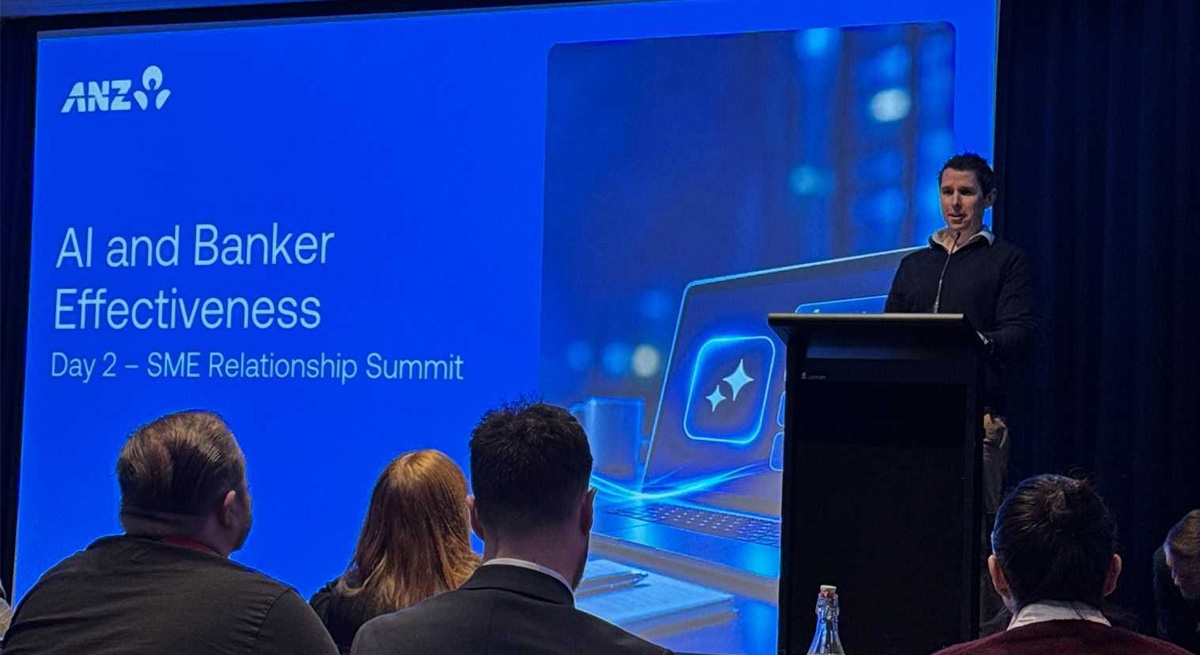
Arcadian Digital founder Adrian Randall was invited to close out ANZ’s VIC/TAS SME Wholesale Summit in November with a session on AI and banker effectiveness.
The room was full of relationship bankers who already use AI to draft emails and summarise notes. That matches the wider picture: ABS data shows AI use in Australian financial and insurance businesses rose from 1% in 2021-22 to 24% in 2024-25. The question for the session was: Where does AI fit in a banker’s everyday workflow, and what do we do with the time it saves?
The win isn’t the time you save, it’s what you do with it
The efficiency case for AI is real. An NBER study of 5,179 support agents found AI assistance lifted productivity by 14%, and by 34% for newer staff. But saved time only matters if it’s reinvested.
Any good client/banker catch-up is mostly background, with perhaps 20% that turns out to matter, and you can’t know which part that is until you’re in the room. So the way to find more opportunities is to have more conversations. If AI takes care of the preparation, bankers can spend that time with clients, making proactive calls instead of waiting for clients to come to them.
From prompts to agents, workflows and connectors
Most people start by typing a prompt and getting an answer. The shift now is towards systems that keep working in the background, built from three parts:
- Agents are given a goal and work towards it, such as reviewing a client list for people who would benefit from lower fees.
- Workflows are repeatable processes. An example is one that runs every Monday morning, looks at what has changed (rates, products, client circumstances) and flags who is worth a call.
- Connectors give the AI controlled access to approved systems, so it works with real customer information and not guesswork.
Put together, you get a Monday run sheet: who to contact this week, why, and what to talk about.
AI prepares, the human decides
The first concern people raise is what happens if it gets something wrong. The research supports taking that seriously. In a Harvard/BCG study, consultants using AI were 25% faster, but about 19% less accurate on tasks outside AI’s strengths.
That’s why everything Arcadian builds has human checkpoints. The AI gathers information and drafts the next step, a person checks the facts and applies judgement, and only then does action follow. A large language model is like a very well-read colleague that doesn’t know your business until you give it context, so it needs good information going in and validation coming out. People remain accountable, which matters even more in banking.
Clients expect you to be proactive
AI doesn’t mean fewer jobs so much as higher expectations. Clients expect more, faster, and they expect you to anticipate what they need next. They are time-poor too, so they often struggle to articulate their own problems. If you can describe their problem more clearly than they can, you’ve usually already won their trust. As customers start using AI themselves, they’ll arrive better informed but not always well advised, and that’s where a banker’s judgement counts.
There are more possibilities than most people think
AI isn’t limited to the obvious use cases. Arcadian’s work spans transport, logistics, construction and manufacturing, including turning emails into design files for machinery and helping plan how to pack and route a truck. The recipe is the same each time: an agent, a workflow, connectors and a human in the loop.
One task to try
The session closed with a simple challenge: pick one recurring task where AI could save you time, and decide how you’d use that capacity to do something valuable for a customer.
Thanks again to everyone in the room. It was a great group with sharp questions and a clear appetite to put this into practice.